Published on 11/30/2025
Orval, Guardian of Time, Wealth, and Efficiency
Less Time. More productivity.
When working on modern applications whether it's a PWA, a mobile app, or a backoffice panel one of the most time-consuming tasks is integrating APIs.
You open the API documentation, and suddenly you're staring at dozens or even hundreds of routes that must be implemented, typed, and maintained.
Manually writing API calls for all of them is not only repetitive but also error-prone.
This is exactly where Orval comes to the rescue.
What Is Orval?
Orval is a RESTful API client generator that turns your OpenAPI specification into fully typed, ready-to-use client code.
Instead of writing HTTP methods, request types, hooks, and cache logic manually, Orval produces everything automatically with a single command.
It supports:
- Client generation
- Request validation
- Response typing
- Caching strategies
- Auto-mocking
- Multiple frameworks (React Query, SWR, Axios, Fetch, etc.)
Orval’s goal is simple:
Write less boilerplate, focus more on productivity.
The Problem with Manual API Implementations
When building large systems, it's common to have:
- A public web application
- A mobile application
- An internal backoffice interface
Each of these layers needs to communicate with the backend, and each has its own API requirements.
If you implement every route manually in every environment, you end up repeating the same logic again and again, leading to:
- Code duplication
- Inconsistency between client implementations
- Missing or outdated types
- Higher maintenance cost
- Slower development cycles
By the time you complete writing API clients for one project, the backend team has already pushed new endpoints or updated schemas.
How Orval Solves These Challenges
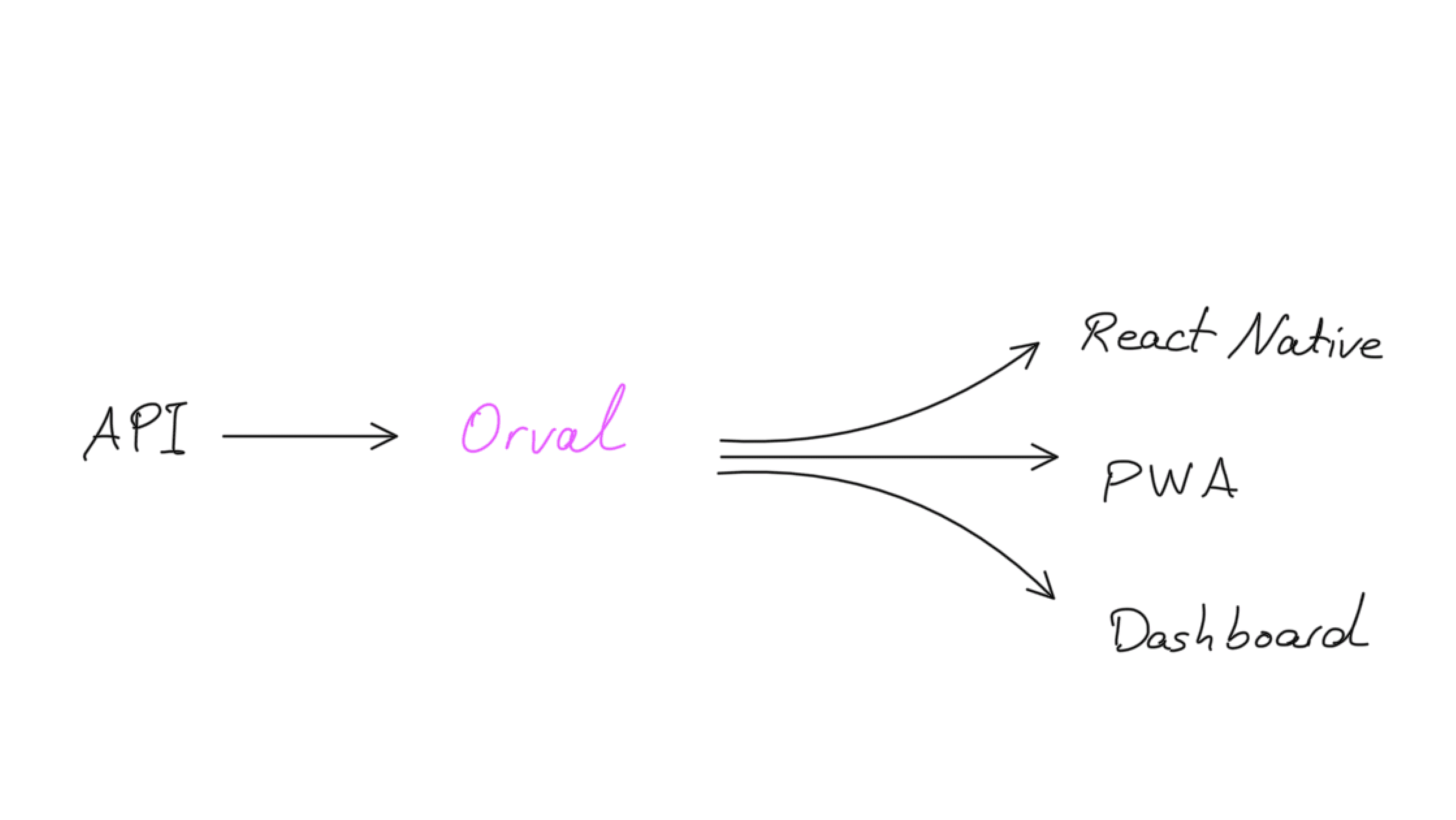
Orval automates the entire process, and once your OpenAPI document is ready, it can generate everything you need without any manual effort. No more guessing parameters, request bodies, or response types—everything is derived directly from the specification, making it perfect for modern frontend architectures. You can use the same spec to generate clients for your PWA, mobile application, and backoffice, while still defining different scopes, paths, or folders for each project as needed. Orval also allows full customization of naming, imports, and behavior, ensuring that the generated code fits seamlessly into your architecture. And if your backend isn’t ready yet, you can instantly generate mock APIs and start building UI components right away, keeping your development flow fast and uninterrupted.
Working with OpenAPI Specifications
Orval reads your OpenAPI (Swagger) document and turns it into a complete frontend integration layer.
With that, you can:
- Validate API structures
- Keep API clients always in sync with backend updates
- Benefit from auto-generated types and error handling
- Reduce runtime bugs by relying on compile-time safety
- Cache requests using your chosen client (React Query, SWR, etc.)
A simple orval command regenerates everything no manual updates needed.
Mock APIs with Zero Effort
One of Orval’s underrated features is its ability to mock all endpoints automatically.
This is incredibly useful when:
- Backend APIs aren’t ready
- You want to test UI quickly
- You want predictable fake data
- You want to simulate edge cases
Orval creates mock handlers that behave exactly like your actual endpoints, making development much smoother.
Why You Should Use Orval
If you’re maintaining multiple applications or working with a large API surface, Orval offers:
- Speed: Generate clients instantly
- Accuracy: Types stay synced with backend
- Consistency: Same logic across all projects
- Scalability: Perfect for growing teams and big codebases
- Developer happiness: Less boilerplate, more meaningful work
In short, Orval helps you write less code and deliver more value.
Conclusion
API integration doesn’t need to be painful or repetitive.
Tools like Orval let you focus on the important parts of your application while it handles the boring parts client generation, typing, caching, and mocking.
If you want to boost your productivity and maintain cleaner codebases, Orval is definitely worth adding to your workflow.